
Storytelling has its place. A good origin story, or founder’s journey, helps people understand who you are. But when it’s time to choose a supplier, renew a contract, or justify a decision to a buying committee, warm and fuzzy doesn’t close the deal.
Every company shares a different movie. One founder survived on credit cards and beans before breaking through. Another is fourth generation, proudly carrying grandpa’s legacy. Compelling? Sure. But neither story answers the one question every buyer is actually asking: why should I choose you over the other guy? Are you handing out Tony Awards or building a value proposition?
There’s a difference. A story explains where you came from. A value proposition tells the customer how you reduce their risk, improve their outcomes, and make their life easier — specifically and provably.
QuickBooks doesn’t just say “we make accounting easier.” It says customers who combine accounting, payroll, and time tracking save an average of 3.95 hours per week and generate nearly 10% more billable time. HubSpot doesn’t say “we help companies grow.” It reports 84% of customers see revenue increases and 95% achieve positive ROI. Wheels Up doesn’t talk about the joy of private aviation — it announces 74 consecutive days in 2026 without a single canceled flight. No founder backstory needed. Just facts that close sales.
This isn’t just my opinion. Forrester finds that B2B buyers struggle to trust vague vendor content. Gartner says buyers need confidence, clarity, and simpler decision-making. LinkedIn’s B2B Institute found that much B2B creative simply underperforms. The problem isn’t storytelling — it’s storytelling without proof.
Buyers today are under pressure. Procurement is more involved. Margins are tighter. The buyer doesn’t need goosebumps. They need fewer headaches. And you can’t deposit “brand narrative” at the bank.
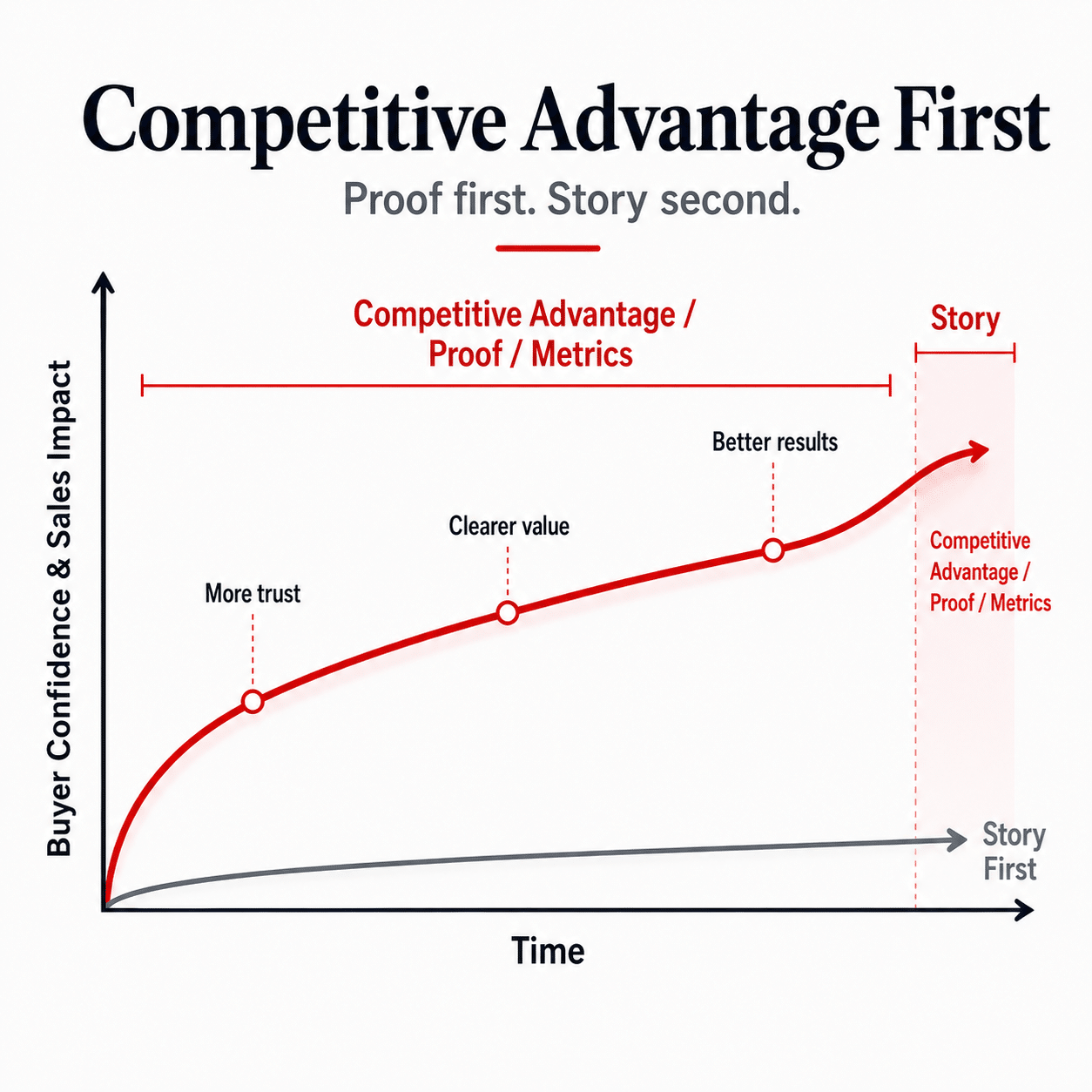
Get the competitive advantage right first. Prove it. Then build the story around it. Lead with story and never get to the proof, and you risk sounding interesting — without sounding better.
Customers may remember your story. But they buy the result.
June, 2026