
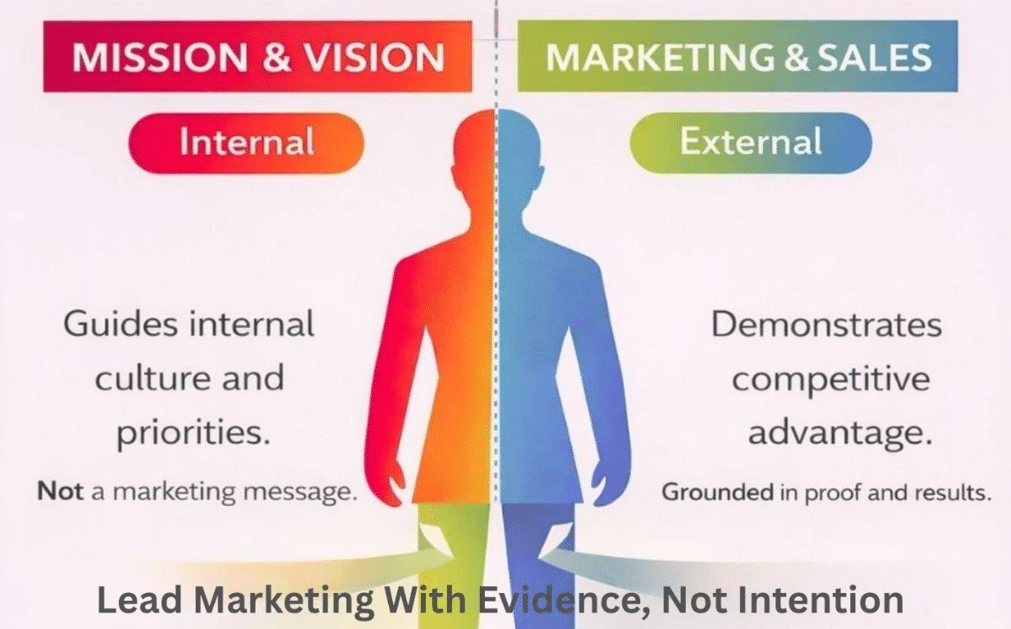
Many companies prominently display their Mission and Vision statements on marketing communications including their websites. That’s understandable — you’ve invested time crafting them, they reflect your culture, and they help align your team. If the primary purpose of your marketing is internal – think employee motivation – that’s okay. But if the primary purpose of your marketing is to get and keep customers, it’s not.
Mission and vision are internal alignment tools.
Competitive advantage is an external buying decision tool.
When a prospect is considering your company they are asking:
- Do you understand what matters most to customers like me?
- Can you prove you perform better where it counts?
- Ultimately, why should I pick you?
Those are buying questions — and they’re answered by Customer Relevant Indicators (CRIs), not aspirations.
For example, if research shows customers are most interested in having their orders shipped on time and in full, shouldn’t your mission reflect that?
Mission statements describe what you intend to do.
CRIs demonstrate what customers have actually experienced.
If your marketing message leads with purpose instead of proof, you may miss the opportunity to immediately signal what differentiates you in the market.
High-performing homepages lead with validated competitive advantages, such as:
- Customer-valued performance metrics
- Evidence-based “why us” statements
- CRIs that outperform alternatives
- Proof drawn from customer research, not internal opinion
These elements answer the buyer’s core question quickly and credibly:
“Why should I choose you?”
Mission and vision still matter — deeply. They inspire your people to deliver.
Your mission belongs in leadership conversations and culture initiatives.
Your Customer Relevant Indicators prove what you have succeeded at that matters to customers
In marketing, lead with competitive advantage — validated, customer-relevant, and measurable.
Purpose inspires your team.
Proof earns you customers.
January, 2026