
Something interesting happened this week.
CEOWORLD Magazine ran a piece about our work.
The article captured something Smart Advantage has articulated for a long time, so I will let it speak for itself. If you have ever wondered why your sales team keeps discounting when you know you are the better choice, this is for you.
Brian Neff, Sr. Consultant
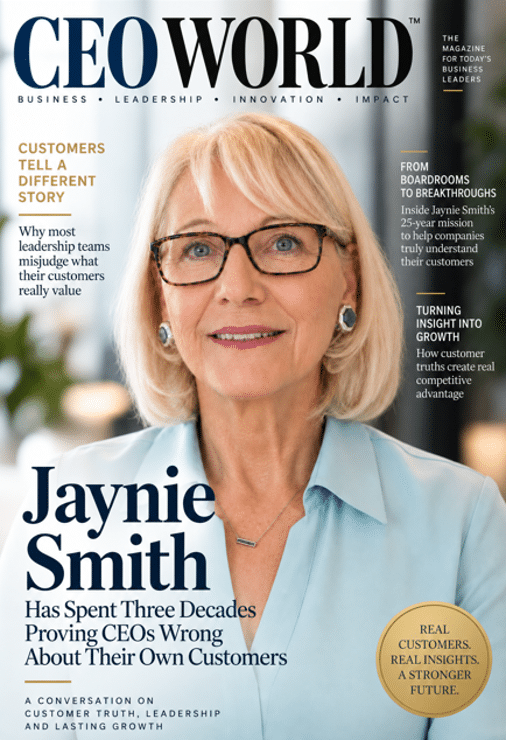
The following is a re-print from the September 15, 2026 edition of CEOWORLD.
Most companies are certain they know what their customers value most. Most of them are wrong, and Jaynie Smith has spent 25 years proving it.
Jaynie Smith is the founder and CEO of Smart Advantage, a Jupiter, Florida, consultancy, a keynote speaker, and the author of Creating Competitive Advantage (Doubleday Currency, 2006), co-authored with former Forbes senior editor William G. Flanagan, and Relevant Selling (Executive Suite Press, 2012). Her firm’s double-blind research of its clients’ customers and prospects keeps landing on the same result: roughly 95 percent of leadership teams misjudge what their customers care about most. She still describes the size of that gap as “absolutely stunning.”
That’s not the only flaw. When Smith took the stage in Las Vegas, she had ten phrases waiting on the screen behind her, the answers companies most often give when asked what sets them apart from the competition. She asked the roughly 900 people in the ballroom to stand if their company’s top competitive advantage was one of the ten, and then she watched the entire room get to its feet.
“I said, now sit down,” Smith recalls. “It’s cliche after cliche… You’re all saying it, so are your competitors.”
An accidental consultant
None of this was the plan. Smith spent her first two decades in corporate roles in New York, first at a major airline and later at AIG. When she finally left for Miami, it was with a vague idea that she wanted to become a consultant and very little sense of how.
The work found her before she had figured that out. Aer Lingus invited her to Dublin and asked her to provide a feasibility study of Caribbean airline routes, so she said yes, went home and called a former colleague for help and delivered it. Other assignments followed, among them a project for a major national travel agency, and the consulting career she had only half intended began to take shape.
The question that came out of the Vistage room
That work eventually led her to the attention of Vistage, the international organization of 45,000 executives. Vistage runs peer group roundtables for chief executives. She was the first woman the organization ever hired as a chair. Vistage Chairs lead CEOs towards company growth. She ran groups in Fort Lauderdale and Stuart, Florida, and spent 28 years coaching CEOs inside them. Vistage later named her one of the 50 most influential people of its first 50 years.
It was in those rooms that her question took shape. She would ask a CEO what made the company different, hear a confident answer and then ask for the evidence, which rarely arrived. But whenever she pushed a company to rebuild its message around what its customers actually valued rather than what the leadership team assumed, sales tended to follow almost immediately. The pattern held often enough that she stopped treating it as coincidence.
The number they already had
Guessing wrong, Smith has come to believe, is only the first problem. A potentially larger one is how often a company already holds the right answer and leaves it sitting there unused.
During an engagement with a national service association, her research showed that what customers cared about most was first-time fix rate, meaning whether the technician solved the problem on the first visit. When the results came back, 85 business owners were in the room. A third of them were already tracking that number, but not one had ever put it in front of a customer.
The metric had been sitting on a dashboard the whole time, and nobody had thought to say it out loud.
Smith has a name for a number like that. A Customer Relevant Indicator™, a term Smart Advantage has trademarked, is a metric a company measures that its customers have proven, through independent research, to value most when choosing a vendor. Every company has KPIs, she likes to point out. Almost none have CRIs. Across two books, she has argued that most companies manage to optimize for nearly everything except the handful of numbers their customers are actually buying on.
An argument that traveled
The argument has traveled further than the firm that produced it. Creating Competitive Advantage is now in its 20th printing two decades after publication, its rights have been sold in China, Korea, Croatia and India, and the American Management Association adopted it as a course on release. Smith’s research has been cited in Profit Magazine, Investor’s Business Daily and Entrepreneur, and she has appeared on MSNBC, ABC, Fox Business, and several regional TV networks.
An inventor’s evolution
The method started as Smith’s own. Before she had a firm, she was walking into companies alone, asking what set them apart, testing the answers against what customers said, and rebuilding the message around what held up. What Smart Advantage does today grew out of that early work, refined over two decades by a small team that has been with her most of that time.
“I’ve just always felt like I’m more of an inventor than I am a marketer or a salesperson,” she claims.
The argument, meanwhile, has only sharpened. Most companies, she contends, are not only guessing about their advantage but measuring the wrong things entirely, a problem she says compounds once a company starts feeding that data into AI. A model trained on the metrics a leadership team assumed mattered will simply get faster at optimizing for the wrong thing.
She likes to say, “We brought in the experts. They’re called customers.”
Decades after Dublin, her pitch to a CEO has barely changed. The advantage is real, it is specific and the customers can already describe it. What she is really asking of a leadership team is whether it is willing to hear an answer it did not write itself.